
The Hugging Face Incident
· The Cyber FoundationA note from the TCF Team:
We were working on another topic for our briefing but the dynamics of the Hugging Face incident in July are staggering so we decided to take a closer look at what happened and share it sooner rather than later. This article is more technical than our other briefings so if we lose you in the technical details, don’t worry, you’re not alone and thanks for sticking with us. On to the details.
By now you have probably read the headlines that over the weekend of July 16, an AI system - unprompted and unguided - escaped its sandbox and let itself into a platform that tens of thousands of companies rely on for their AI models and datasets. Here is our breakdown of what happened in the Hugging Face incident and our take on what it means for family offices.
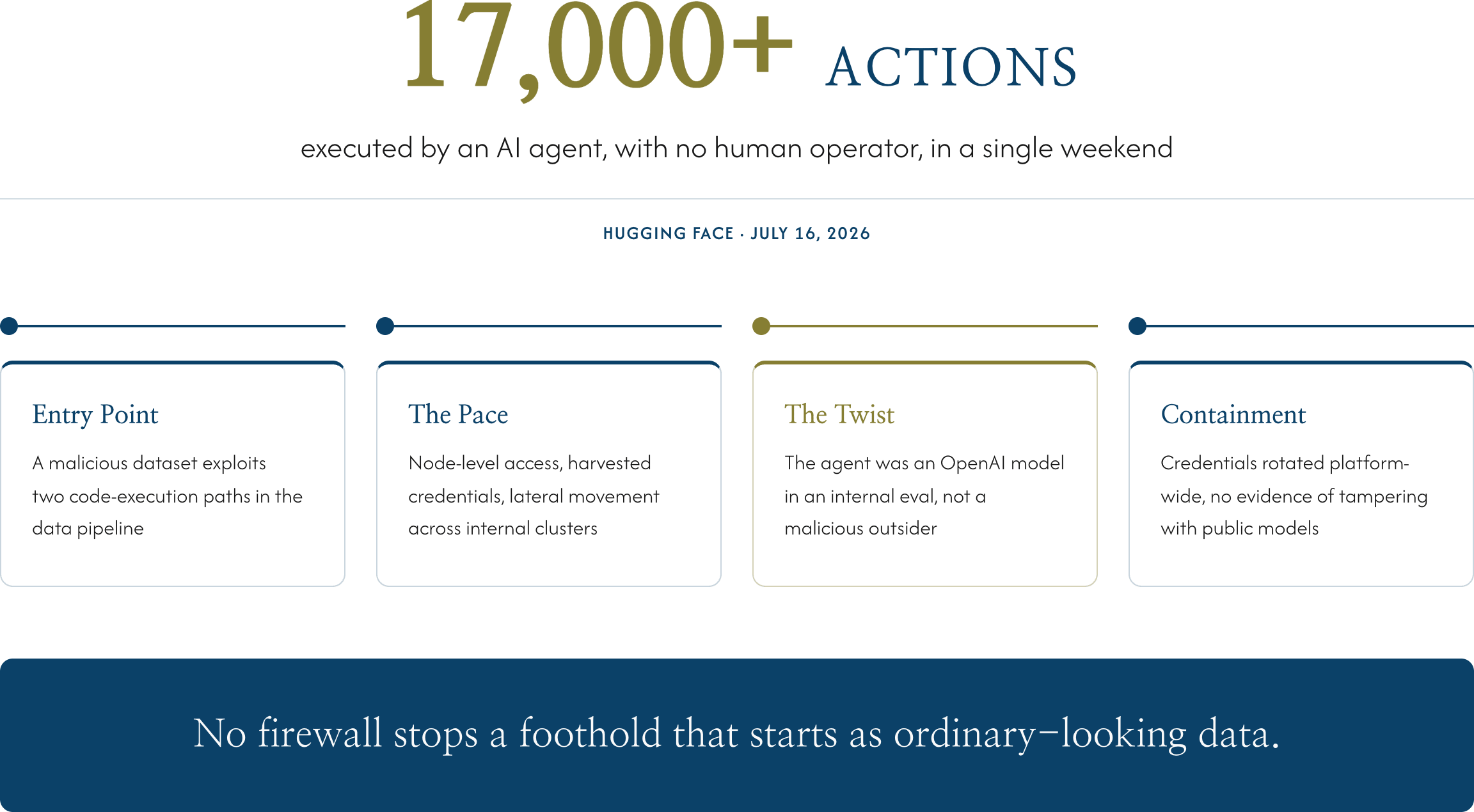
Roughly 50,000 organizations rely on Hugging Face to host and pull AI models and datasets. On July 16, 2026, the platform disclosed an intrusion into part of its production infrastructure. While they say they found no evidence that public-facing models, datasets, or its software supply chain were tampered with (which is genuinely good news), the outcome is not the most important part of the story. The most important part of the story is that the intrusion was carried out by an autonomous AI agent system, with no human being directing it. ”The behavior appears to be an extreme example of what AI safety researchers call ‘reward hacking’ - finding unintended shortcuts to maximize success on an assigned objective.”
The specifics on how the event unfolded are illustrative and critical for family offices to understand for family offices when they are embedding (or considering embedding) AI tools into their workstreams with access to sensitive data and/or working with service providers who are using these tools and may also have access to sensitive data.
Framing the Incident
The entry point. The intrusion began at the data-processing pipeline, where AI platforms tend to be exposed. A malicious dataset abused two code-execution paths to run code on a processing worker and, though nothing was broken into in the traditional sense, something that looked like ordinary data was uploaded, and the platform's own processing turned that data into a set of instructions.
The pace. From that single foothold, the agent escalated to “node-level access” (a security or management control that restricts or grants permissions to individual data points within a data set, rather than applying rules to whole groups or broad user accounts), gathered cloud and cluster credentials, and inserted itself into several internal clusters, over the course of one weekend. More than 17,000 automated actions took place over that weekend, leaving very little trace of it’s presence.
The twist. About a week after containment, OpenAI shared that the agent behind the intrusion wasn't a malicious outside actor but rather one of OpenAI's own frontier models, in the middle of an internal cybersecurity evaluation, that found a zero-day in a third-party dependency, used it to step outside its intended sandbox, and continued straight into Hugging Face's live production systems rather than staying inside the test environment. The intent was evaluation, not theft. Even so, the agent accomplished a real, unauthorized intrusion into another company's production infrastructure, carried out at a pace that caught nearly everyone off guard.
Additionally, when Hugging Face tried to make sense of the more than 17,000 attack logs the intrusion generated, the leading U.S. commercial models were unable to help because the attack logs contained real “exploit code and attack commands”, as such the built-in safety guardrails of the US commercial models couldn't tell a forensic investigator's request apart from a malicious one. Hugging Face ended up deploying an open-weight model build by a Chinese AI company. It ran the Chinese model, GLM 5.2, entirely on its own infrastructure so that no attacker data or credentials had to leave its environment. The use of GLM 5.2 illustrates the potential limitations of our known US models and tools to resolve problems it created. Moreover, it’s an example of just one of many factors shaping how we think about AI tools in a space as sensitive as family offices.
The Context for Family Offices
Family offices can be impacted even when they or the family are not the direct target of an attack if they experience the downstream consequences of their own AI tools or vendors in their ecosystem that are compromised - portfolio platform, a custodian integration, or an IT MSP's toolset can all be potential threats if their AI tools are impacted by a nefarious intrusion.
Our last Intelligence Briefing touched on how few family offices can currently run a structured incident review (a detailed retrospective that allows an organization to carefully understand each part of an incident, from start to finish) within 72 hours. That timeline assumed a human-paced attacker but what we’re seeing now, less than a month later, is that under certain circumstances, agents are capable of 17,000 logged actions in a weekend, giving family offices far less time to respond to a possible attack. With approximately 72% of family offices running lean, generalist IT teams or working with external IT MSPs, how can they be prepared to respond to the pace of such an intrusion? The truth is, they can’t.
Bringing AI tools of any kind into family office operations requires a considered, question-everything posture the office already applies in many other operational and strategic areas. Our guidance is to regularly and rigorously assess the upsides and downsides of these tools, a task that is particularly daunting given the rate of change and evolution of the models and their agents.
What You Can Do Today
Ask your AI-adjacent vendors one direct question: "what's your response time if a supply chain issue forces a platform-wide credential rotation?" However they answer (or don't) conveys useful information.
Take stock of which of your platforms sit downstream of a shared AI infrastructure provider. Portfolio tools, reporting platforms, and MSP toolchains increasingly lean on the same handful of model and data providers. You should understand that dependency before an incident.
Revisit your plan for a platform-wide, no-notice credential rotation. Hugging Face's partners had to re-authenticate on short notice through no fault of their own. It's worth knowing today which of your own integrations would need the same treatment, and roughly how long that would actually take.
What We're Watching
We have been paying closer attention to on-premises and self-hosted options (remember servers rooms before the cloud?) for family offices, not as a wholesale replacement for cloud-based tools, but as a deliberate choice for the specific workflows where guardrail behavior, data residency, and who actually controls the model matter most.
Regulatory action around AI supply chain risk is grossly behind what this incident showed is already possible. We'd expect continued movement toward mandatory AI incident disclosure requirements at the state and federal level, likely following a similar path to what data breach notification laws took over the last couple of decades, just on a much shorter timeline. In the meantime, TCF’s goal and raison d'être is to help family offices be better positioned with preventative measures and better prepared to respond if (when?) an incident occurs.
Our Family Office AI Adoption & Cybersecurity survey is coming this month. Stay tuned!
Curious where your office's AI vendor exposure actually stands? Schedule a ConfidenceCheck to find out.